
Let’s Get Gardening!
First – please accept my apologies for the lateness of this month’s newsletter. I took a few days away from the store, and thought I would have lots of time to do things like write the newsletter, but the week just flew by! I did, however, get some time in for relaxation (and a little planting)!
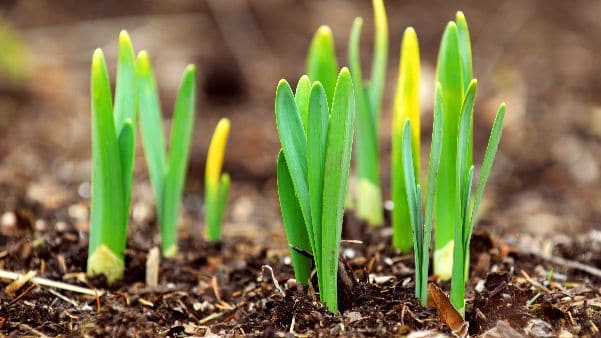
April is such a great month for gardeners – we get so hopeful as we start to see plants popping up out of the ground and buds forming on trees, the songs of frogs and birds begin to fill the air, and days grow longer. All of these things tell us it’s time to get gardening!
Jennifer
This month’s issue of Let’s Get Gardening
Subscribe to our monthly newsletter for seasonal gardening advice and recommendations for your garden, yard, and bird feeding.
With the quick warm-up we seem to be getting, it’s tempting to get outside and start planting. Don’t be in too much of a hurry though – it’s important to know when to plant what, in order to give your plants the best chance to thrive. There are still lots of things you can do, both indoors and out, though.
Indoor and Outdoor Gardening Tasks:
- If you didn’t do it in the fall or over the winter, make sure your garden tools are ready for the season – sharpen and clean pruners, loppers, and shovels (you can find many videos online to help you properly sharpen all of your garden tools); check gloves and garden hoses for holes; assess garden supports and stakes to make sure they are in good shape. Replace whatever won’t make it through the season.
- Start eggplant, pepper, and tomato seeds indoors now, so they will be ready to put out in your garden in about eight weeks.
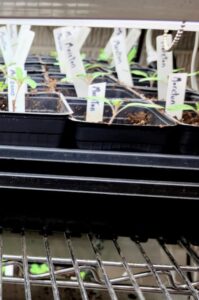 These heat-loving plants should not go outside until all chance of frost has passed, and nighttime temperatures are consistently above 50°, which is usually around Memorial Day.
 - Before starting to plant outdoors, test your soil. Your soil conditions change over time, so it’s best to do this every year. Knowing what your soil is lacking makes giving it what it needs to support good plant growth so much easier.
- As it starts to warm up, pulling mulch away from plants that are starting to poke up out of the ground can help the soil warm up more quickly, and can help to reduce mold. Add compost to the soil around your plants after you have removed mulch. This helps improve the soil’s structure and adds nutrients. Wait to add new mulch to your planting beds, trees, and shrubs until the soil has warmed up fully – usually after Mother’s Day, or even as late as Memorial Day weekend.
- If you haven’t gotten the chance yet to clean up all the debris from our March weather, a warm, sunny day in April is a great time to do it. If you have the ability to pile the debris somewhere on your property that is out of the way, you can provide habitat for creatures, including some bees, butterflies, and other beneficial insects.
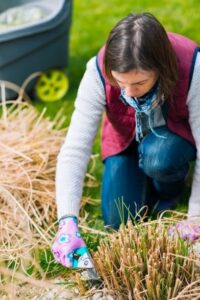
- When daytime temperatures are consistently in the 50’s, cut back grasses and most perennials that you have left standing over the winter. The reason to wait until it has warmed up is to give the beneficial insects that have spent the winter in the hollow stems and on the leaves of your plants a chance to wake up. If you just have to cut things back and clean up earlier, don’t discard what you remove – carefully place it somewhere else on your property that is out of sight.
- Wait to cut back semi-woody and woody perennials until the end of the month, then decide how much you want to trim based on where you see new growth, and how you want the plant to appear.
- Early April is the time to apply weed preventer to your lawn. Weed preventers help keep the seeds of dandelion, crab grass, and other weeds from putting down roots when they germinate.
- Once your garden’s soil is workable, it’s time to start planting cool-season crops, such as pea, lettuce, and spinach seeds. Radishes and carrots like slightly warmer soil, as do cabbage, kale, broccoli, and cauliflower transplants, and onion sets. The best way to know when to plant anything is by checking the soil temperature. All plants thrive at particular temperatures or ranges of temperatures. If you plant too soon, seeds will more likely rot before they can germinate, and transplants can end up being stunted and not produce well.
- Pansies and primrose can also go out now, but keep row covers handy – even though it’s warming up nicely at the moment,
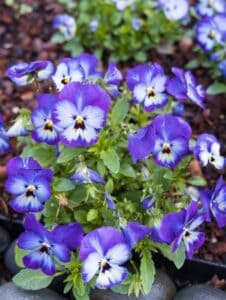 we all know what April in Michigan can be like. Row covers can help protect your plants from frost and freeze, by keeping the warmth of the soil around the plant.
 - Sweet pea seeds can be planted outdoors when soil temperatures have reached 50°, bachelor’s buttons and calendula at 60°, and most other spring annuals when the soil is at least 65° to 70°.
- Towards the end of the month, divide summer-blooming perennials that you didn’t get to in the fall (you can divide spring-bloomers, but they may not bloom this spring).
- Plant dormant trees and shrubs once the soil can be worked. Proper planting of trees and shrubs is important in ensuring that they survive and thrive. The Arbor Day foundation has details for planting various types of trees, which can also be applied to shrubs.
For the Birds:
- If you don’t have bird houses up yet, get them up now. I have seen lots of bluebirds checking out my nesting boxes already,
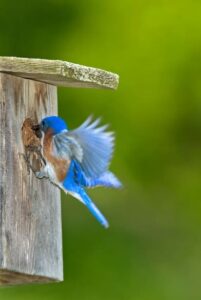 so I’m hopeful that I’ll have bluebird babies in my yard this spring. If you’re interested in attracting bluebirds to your yard, the Michigan Bluebird Society has lots of great tips.
 - Check existing bird houses before cleaning them out to make sure they aren’t already occupied. If the nesting materials in the box look at all new and fresh, leave them – it’s an indication you already have tenants. If the materials look old, clean them out to give the birds a fresh start.
- Another way to help birds during nesting season is to provide nesting materials for your birds. Just be sure you know what is and isn’t safe for the birds, as some things can be downright dangerous. Check out the Cornell Lab of Ornithology’s website to learn the do’s and don’ts of helping the birds out with nesting materials.
- If you are wondering when hummingbirds will start arriving in our area, check out Hummingbird Central’s website that tracks the migration. Right now, they are still a bit south of us, but it won’t be too long before we start seeing them at our feeders, and orioles should be showing up at about the same time. Make sure your feeders are ready for them – check for cracks and replace them if needed. With warmer temperatures, put your feeders out during the day to help early arrivers find food. If the temps dip below freezing at night, be sure to bring the feeders indoors to prevent cracking.
Read More
More info on all of these tips can be found in our monthly newsletter: Read the full April 2023 issue of Let’s Get Gardening
Happy Gardening!

Shop for a Great Cause on Earth Day –
Saturday, April 22!
Join us in celebrating Earth Day, when The Garden Mill will be donating a portion of the day’s proceeds to the Trinh Pifer Intergenerational Garden at the Chelsea Senior Center.
The Intergenerational Garden’s mission is to teach children the joys of gardening, make gardening experiences available for seniors, and provide space and activities for multiple generations to enjoy each other’s company. In addition to providing educational opportunities for gardeners of all ages and skill levels, the garden provides produce for the Senior Center lunch program during the summer.
For more information on the Senior Center and the Intergenerational Garden, visit their website. And Shop at The Garden Mill on April 22nd to support their wonderful work!
April Is Glove Sale Month!
All Glove Are 10% Off All Month
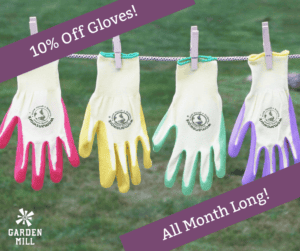
In Store and Online. While Supplies Last.
Cannot be combined with any other offers.
$10 off any $50 purchase

Cannot be combined with any other offer.
Not valid on artist consignment items.
Cannot be used to purchase gift certificates.